
When shopping for affordable coverage, many drivers come across two popular options: no down payment car insurance and low down payment car insurance. At first glance, they may seem similar—but the differences can significantly impact how much you actually pay over time.
Understanding how these two options work is essential if you want to avoid hidden costs and choose the best policy for your situation. In this guide, we break down the real differences, benefits, and potential drawbacks of each.
What Is No Down Payment Car Insurance?
No down payment car insurance allows you to start a policy without paying a large upfront fee. Instead of making a significant initial payment, your costs are typically spread across monthly installments.
This option is especially appealing for drivers who need immediate coverage but don’t have the cash available for a large deposit. You can explore real options and how they work here:
no down payment car insurance.
Key Benefits
- No large upfront payment
- Faster access to coverage
- Better cash flow management
Potential Drawbacks
- Higher monthly premiums
- Possible hidden fees
- Stricter eligibility requirements
What Is Low Down Payment Car Insurance?
Low down payment car insurance requires a small upfront payment, but significantly less than traditional policies. This option balances affordability with slightly better long-term pricing.
If you’re looking for lower monthly costs while still keeping the initial payment manageable, this option may be ideal. Learn more about available plans here:
low down payment car insurance.
Key Benefits
- Lower monthly premiums compared to no deposit plans
- More insurer options available
- Better long-term cost control
Potential Drawbacks
- Still requires an upfront payment
- Not ideal for urgent situations
No Down Payment vs. Low Down Payment: Key Differences
| Feature | No Down Payment | Low Down Payment |
|---|---|---|
| Upfront Cost | $0 or very minimal | Small upfront fee required |
| Monthly Payments | Higher | Lower |
| Flexibility | High (instant access) | Moderate |
| Total Cost Over Time | Often higher | Usually lower |
| Best For | Urgent coverage needs | Balanced affordability |
Which Option Is Actually Cheaper?
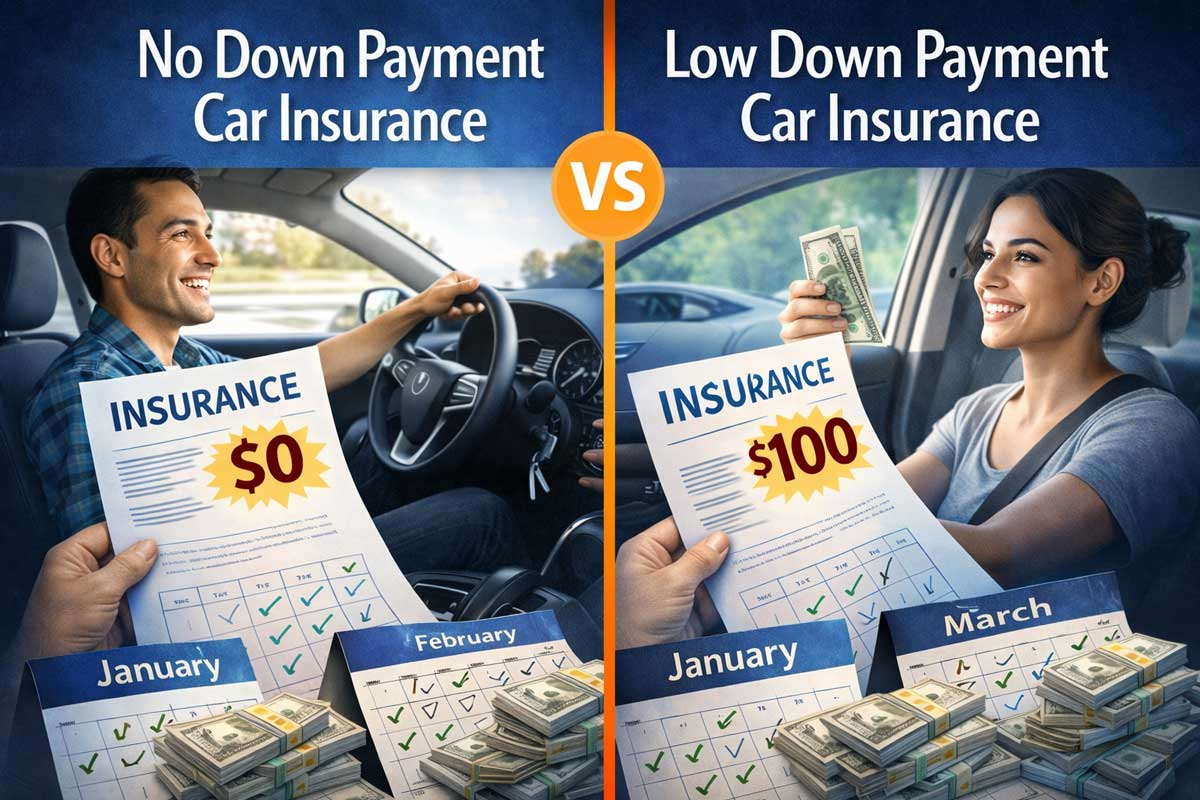
This is where many drivers get confused. While no down payment insurance sounds cheaper, it often leads to higher overall costs due to increased monthly payments and additional fees.
Low down payment policies, on the other hand, require a small upfront investment but can save you money in the long run.
The best option depends on your situation:
- If you need coverage immediately → no down payment may be better
- If you want to minimize total cost → low down payment is often smarter
When Should You Choose No Down Payment Insurance?
This option makes sense if:
- You need coverage urgently
- You don’t have cash available upfront
- You want to start a policy immediately
When Should You Choose Low Down Payment Insurance?
This option is better if:
- You can afford a small upfront payment
- You want lower monthly costs
- You plan to keep the policy long-term
Common Mistakes to Avoid
Many drivers choose based only on the upfront cost, which can lead to higher expenses later. Avoid these mistakes:
Ignoring total policy cost
Not comparing multiple quotes
Overlooking fees and payment terms
How Insurance Companies Structure Payments
To fully understand the difference between no down payment and low down payment insurance, it’s important to know how insurers actually structure their pricing.
Insurance companies calculate your total premium first—based on factors like your driving history, location, vehicle type, and coverage level. Then, they divide that amount into payments.
With no down payment plans, the insurer simply shifts more of the cost into your monthly installments. This is why your monthly bill is often higher compared to low down payment options.
In contrast, low down payment policies reduce your monthly burden by requiring a small upfront contribution, which lowers the remaining balance.
How Your Credit and Risk Profile Affect Your Options
Not every driver will qualify for the same type of payment structure. Insurance companies assess risk before offering flexible payment options.
If you have a strong driving record and good credit, you’re more likely to qualify for low down payment plans with better rates. However, drivers with higher risk profiles may only be offered no down payment options—with higher monthly costs.
This is why comparing multiple quotes is essential. Two drivers with similar vehicles can receive very different payment structures depending on their risk level.
Hidden Costs You Should Watch Out For
One of the biggest misconceptions about no down payment insurance is that it’s cheaper. In reality, many policies include additional costs that aren’t obvious at first glance.
- Installment fees added to each monthly payment
- Policy processing or administrative fees
- Higher interest-like charges built into the payment plan
These hidden costs can increase the total price of your policy significantly over time. This is why reviewing the full payment breakdown—not just the upfront cost—is critical.
Which Option Is Better for Long-Term Savings?
If your goal is to minimize total spending over the life of your policy, low down payment insurance is typically the better choice. By paying a small amount upfront, you reduce the amount financed over time.
However, if your priority is short-term flexibility or immediate coverage, no down payment insurance can still be a useful option—especially in urgent situations.
The key is to balance short-term affordability with long-term cost efficiency.
Pro Tip: Combine Payment Strategy with Coverage Optimization
Your payment structure is only one part of the equation. To truly save money, you should also optimize your coverage:
- Adjust deductibles to balance risk and cost
- Remove unnecessary add-ons
- Bundle policies when possible
- Re-evaluate your coverage every 6–12 months
By combining a smart payment strategy with optimized coverage, you can significantly reduce your overall insurance expenses.
Final Thoughts
The truth is simple: no down payment car insurance offers convenience, while low down payment car insurance offers better long-term value.
Choosing the right option depends on your financial situation, urgency, and long-term goals. Always compare both options carefully before making a decision.
Frequently Asked Questions
Is no down payment car insurance really cheaper?
Not always. While it can reduce or eliminate the upfront payment, it often comes with higher monthly installments and a higher total cost over time.
What is the difference between no down payment and low down payment car insurance?
No down payment car insurance is designed to minimize or eliminate the initial payment, while low down payment insurance requires a smaller upfront amount but may lead to lower monthly payments and lower overall policy costs.
Which option is better for drivers on a tight budget?
It depends on whether the main goal is avoiding a large upfront payment or reducing the total cost of coverage. Drivers who need immediate coverage may prefer no down payment options, while those who can afford a small initial payment often benefit more from low down payment plans.